TOPIC 7 · DQ 2 / Taxes & Stocks / written discussion

02The course, in your own words.

The final assignment of the course. Two to three reflective paragraphs — most favored moments, least favored moments, what could be enhanced — plus a nudge to complete the End of Course Survey in your GCU portal.

Discussion · 5 pts Initial post Fri · replies Sun Written prose Course closer
1
Step 1 · materials
Download the assignment

Topic_7_DQ_2.docx

DOCX 5 pts course closer
2
Step 2 · walkthrough
Watch the click-by-click

Every keystroke. Pause anywhere; the embed scrolls independently of the page.

SCRIBE.HOW · YOUTUBE
Step-by-step walkthrough
Coming soon. Check back after the Scribe is recorded.
Video walkthrough
Coming soon. Same material, different medium, recorded over the holiday break.
Same walkthrough, two modes. Use whichever helps you today.
ORIENT · the assignment

What's actually being asked.

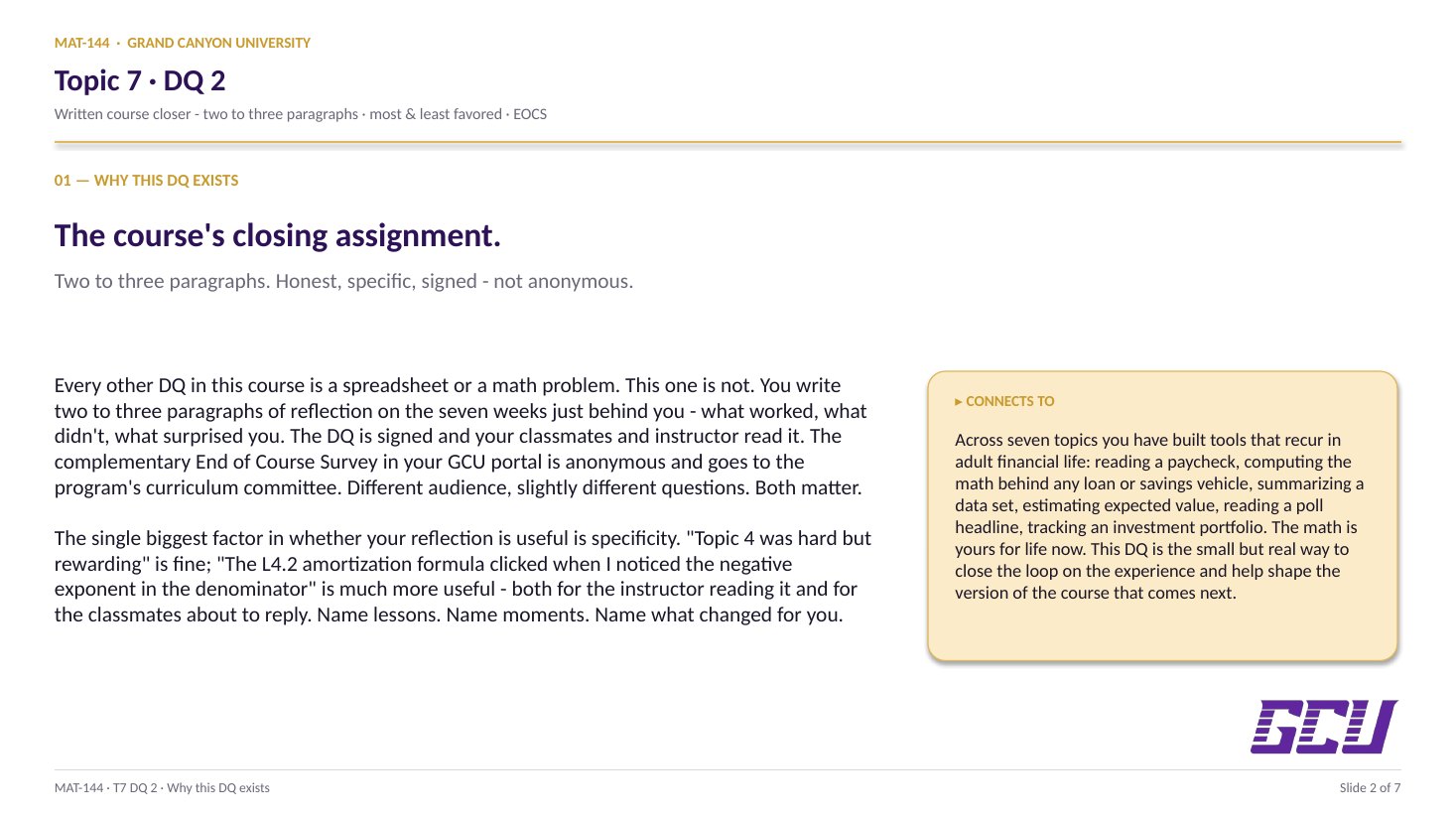
Two to three short paragraphs of honest reflection. No spreadsheet, no math — just your real experience of the course, with specific examples.

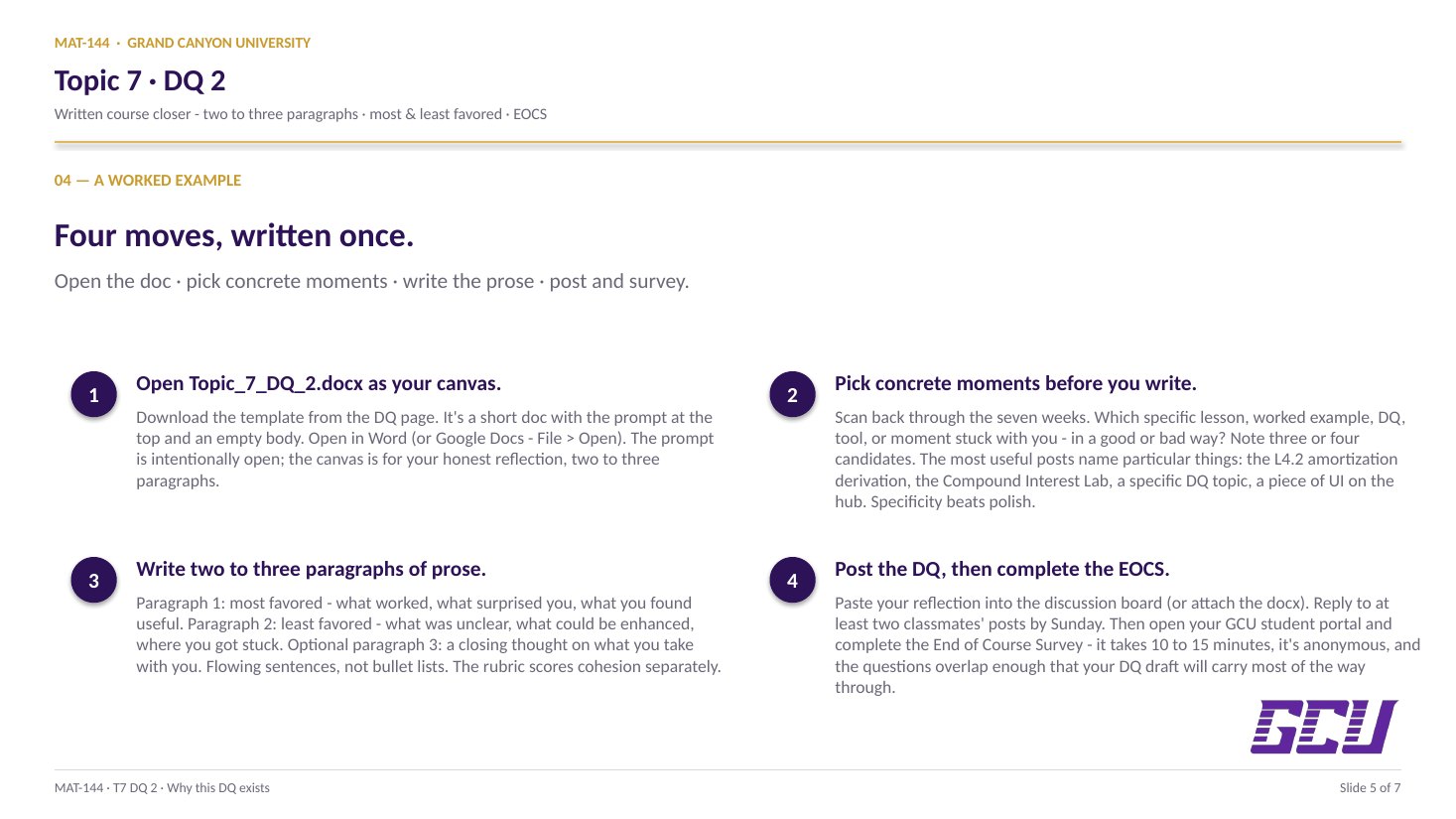
Download the Topic_7_DQ_2.docx template above and use it as your starting canvas. The prompt itself is short: share your most and least favored moments from the course, and reflect on which aspects exceeded your expectations versus which might benefit from enhancements. Write in flowing paragraphs (not bullet lists), name specific lessons or moments, and aim for genuine specificity rather than polite generalities. Submit the completed docx (or paste the text directly into the discussion board) by Wednesday; reply to at least two classmates' posts by Sunday.

Separately, complete the End of Course Survey (EOCS) in your GCU student portal. It is anonymous, takes 10–15 minutes, and goes to the program's curriculum committee. Both this DQ and the EOCS matter, and the two ask slightly different questions.

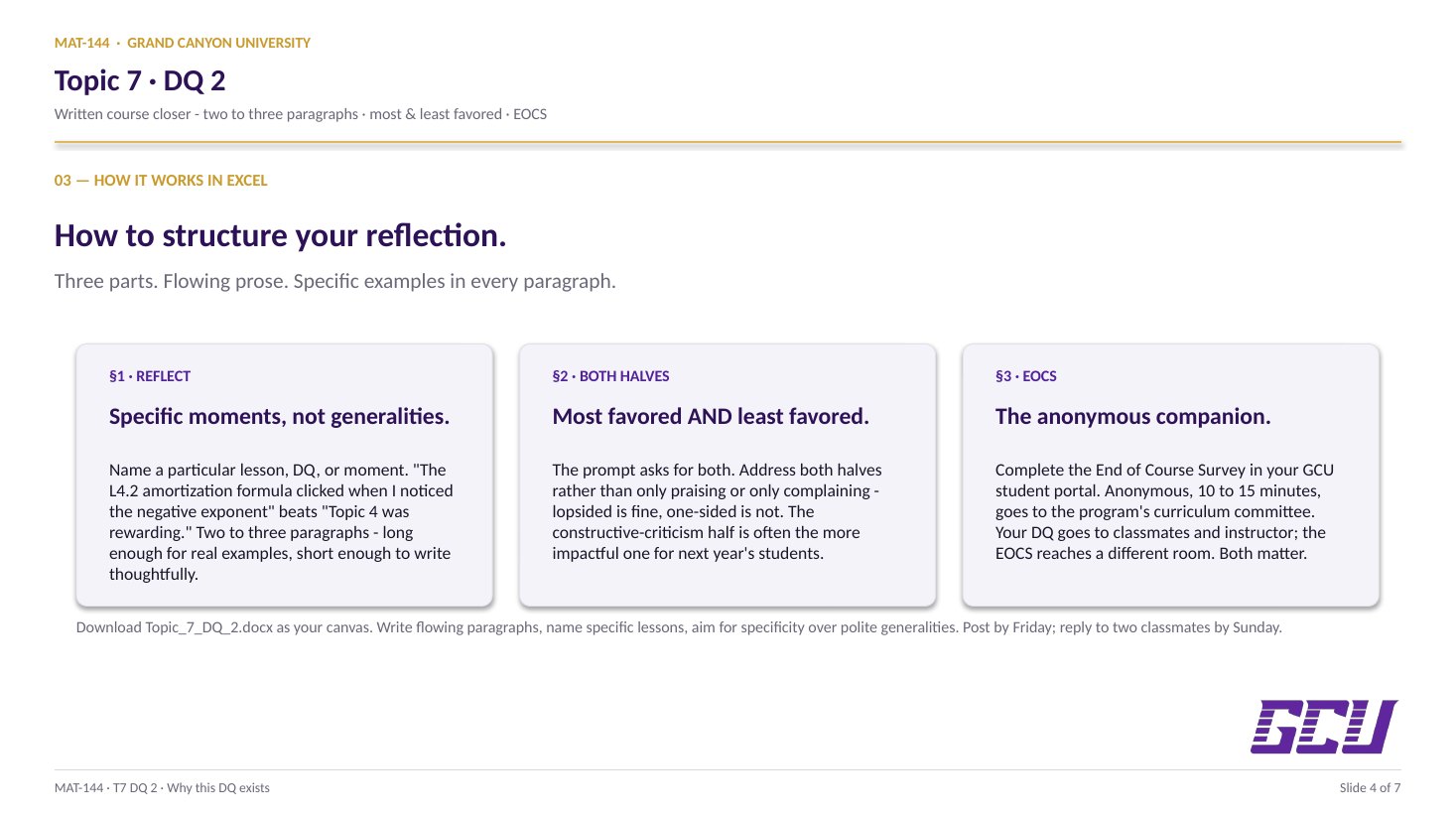
§1 · Reflect honestly

Specific moments, not generalities.

Name a particular lesson, DQ, or moment that worked well or fell short. “Topic 4 was hard but rewarding” is fine; “The L4.2 amortization formula clicked when I saw the negative exponent” is better.

§2 · Both halves

Most favored AND least favored.

The prompt asks for both. You don't have to be evenhanded if your experience was lopsided, but address both halves rather than only praising or only complaining.

§3 · Submit + reply

Wed post, Sun replies.

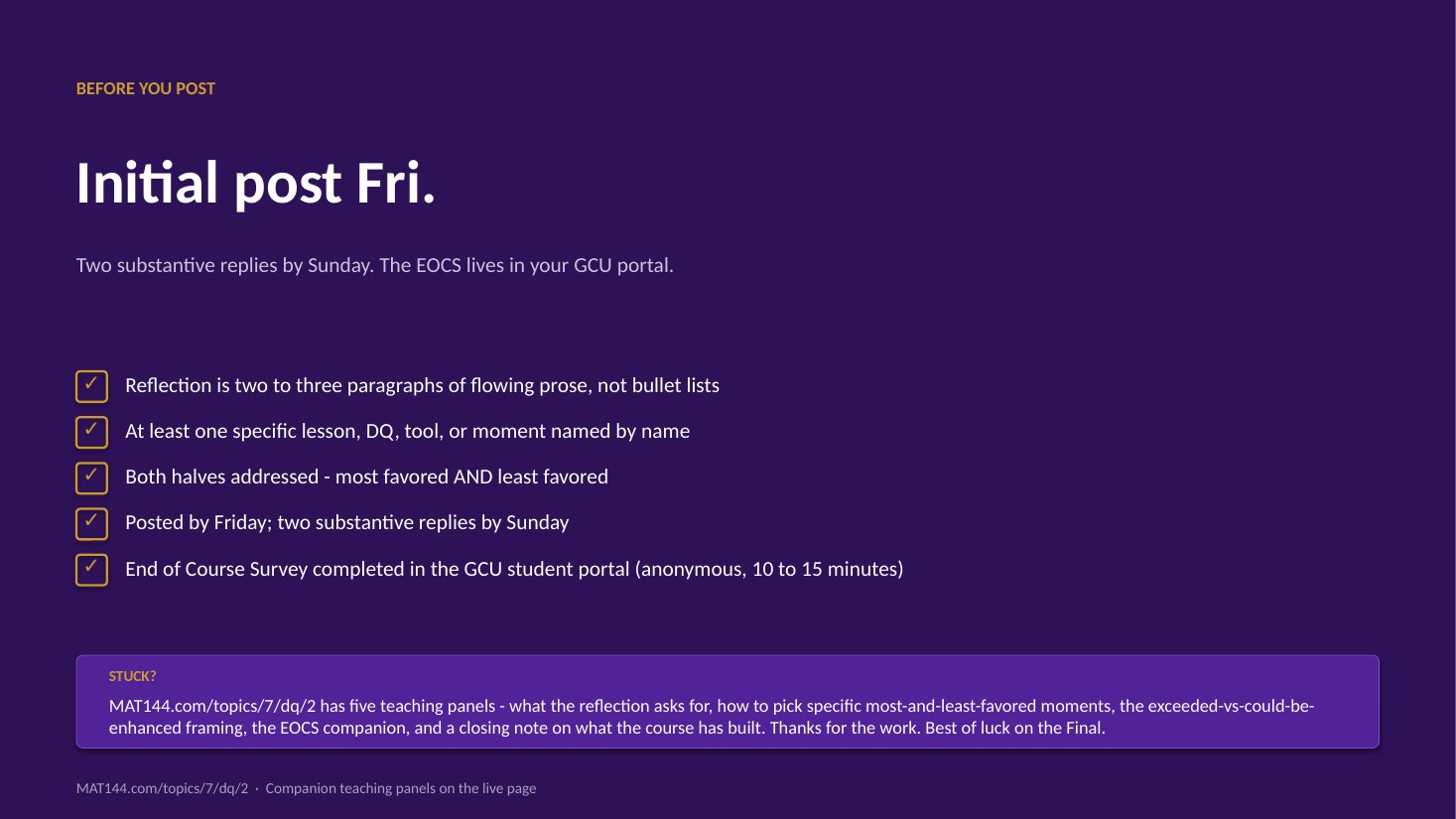
Post your reflection by Wednesday; reply to at least two classmates' posts by Sunday. Replies are how the course's discussion thread closes out.

§4 · EOCS

The anonymous companion.

Complete the End of Course Survey in your GCU student portal. Anonymous, 10–15 minutes, goes to the curriculum committee. Use this DQ post as your draft.

CONCEPTS · six things to know

How to write a substantive reflection.

Five panels: what the reflection asks for, how to pick specific most-and-least-favored moments, the ‘exceeded vs. could be enhanced’ framing, the End of Course Survey companion, and a closing note on what the course has built.

01
The course closer

Two to three paragraphs of real reflection.

The DQ document gives you a short prompt and an intentionally open canvas. You're not being graded on a “correct” answer; you're being asked to think genuinely about your experience and share it.

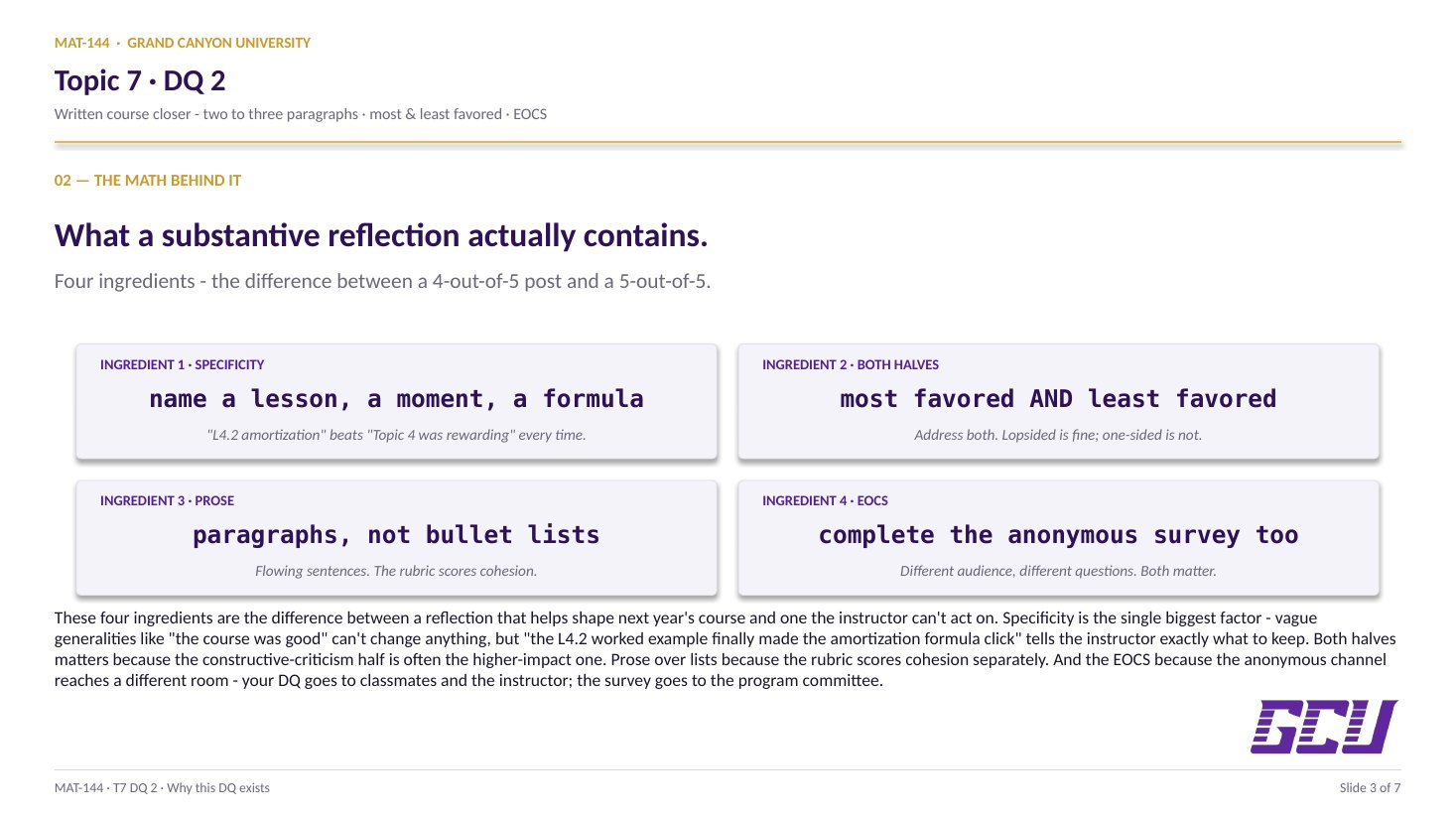
The most useful posts are specific. A post that says “Topic 4 was hard but rewarding” is fine; a post that says “I struggled with the amortization formula in Lesson 4.2 until I realized the negative exponent in the denominator was doing the heavy lifting; once that clicked, the L4 mini-lessons made sense” is much more useful — both for the instructor reading it and for the classmates who are about to reply.

Aim for two to three paragraphs. Long enough to give specific examples; short enough that you can write it thoughtfully in 20 minutes.

02
Most & least favored

Pick specific moments, not generalities.

The prompt asks for both most favored and least favored moments. Pick concrete ones from the actual course material, not generalities.

A moment that exceeded expectations might be: a specific lesson whose worked example finally made an idea click, a tool (like the Compound Interest Lab or the Excel fundamentals page) that you didn't expect to find useful, a DQ topic that connected the math to your own life in a way that surprised you, or a particular discussion-board conversation that taught you something you wouldn't have gotten from the lessons alone.

A moment that fell short might be: a topic that felt rushed or unclear, an assignment whose instructions left you guessing, a particular lesson whose worked example didn't match the ALEKS review question's wording, a piece of formatting or navigation on the hub that confused you, or a concept that you still don't feel confident about heading into the Final Exam.

Both halves are valuable. The constructive criticism half is sometimes the more impactful one — it points at things that could change for next year.

03
Exceeded vs. enhanced

Both halves — be honest, not balanced.

The prompt's second framing is "aspects that exceeded your expectations" vs. "aspects that might benefit from enhancements." This is the same distinction as most-favored / least-favored, but slightly broader: it invites you to comment on the course as a whole rather than just individual moments.

Examples of the former: the textbook (College Mathematics) was a more rigorous companion than typical “course resources” sections suggest; the DQ prompts were genuinely interesting; the AI tutor or other support resources came through when you needed them; the pacing fit your work schedule.

Examples of the latter: a section of the curriculum where you'd have liked more practice problems; a place where the textbook and the lessons diverged in explanation; a UI element of the course site (or ALEKS, or Halo) that consistently slowed you down; pacing that felt too fast or too slow in a specific week.

You don't need to be evenhanded. If your experience was predominantly one or the other, say so honestly. The sincere version of either answer is more useful than a forced “here are three things I liked and three things I didn't.”

TWO HALVES OF THE PROMPT EXCEEDED EXPECTATIONS most favored moments what worked, what surprised you COULD BENEFIT FROM ENHANCEMENT least favored moments what was unclear, what slowed you both halves are valuable; specificity matters more than balance
04
End of Course Survey

The anonymous companion.

The End of Course Survey (EOCS) is the formal complement to this DQ. Where the DQ is your name on a post your classmates read, the EOCS is anonymous and goes to the program's curriculum committee. Both matter, and the questions are slightly different: the EOCS uses standardized rating scales across many courses so that program-level patterns are visible; the DQ is qualitative, specific, and tied to this course.

Access the EOCS through your GCU student portal. The link typically appears a few weeks before the course ends and stays open for some time after. The survey takes about 10–15 minutes and is anonymous, so the most useful version is honest and specific. Mention specific lessons, specific moments, specific patterns — the same advice that applies to the DQ post.

One small habit that helps: fill out the EOCS at the same time you write this DQ post. The two prompts overlap; you can use the DQ as your draft and tighten the survey answers from there.

05
Closing the loop

What the course built.

This DQ marks the end of the course content. Across seven topics, you have built tools that recur in adult financial life: reading a paycheck, computing the math behind any loan or savings vehicle, summarizing a data set, estimating an expected value, reading a poll headline, tracking an investment portfolio. The math itself is durable; the practical applications follow naturally.

The final exam is ahead of you; the Final Exam Review (~38 cumulative ALEKS questions) is your structured preparation. Beyond the exam, the seven topics' worth of math you have built is yours for life. The next time you read a poll headline, calculate a tip, sign a lease, take out a loan, fund a retirement account, or look at a stock quote, you'll be doing it with the full apparatus behind you. That's the practical payoff of this course.

Thanks for the work. Best of luck on the Final.

Common slips

Five things to avoid on the reflection.

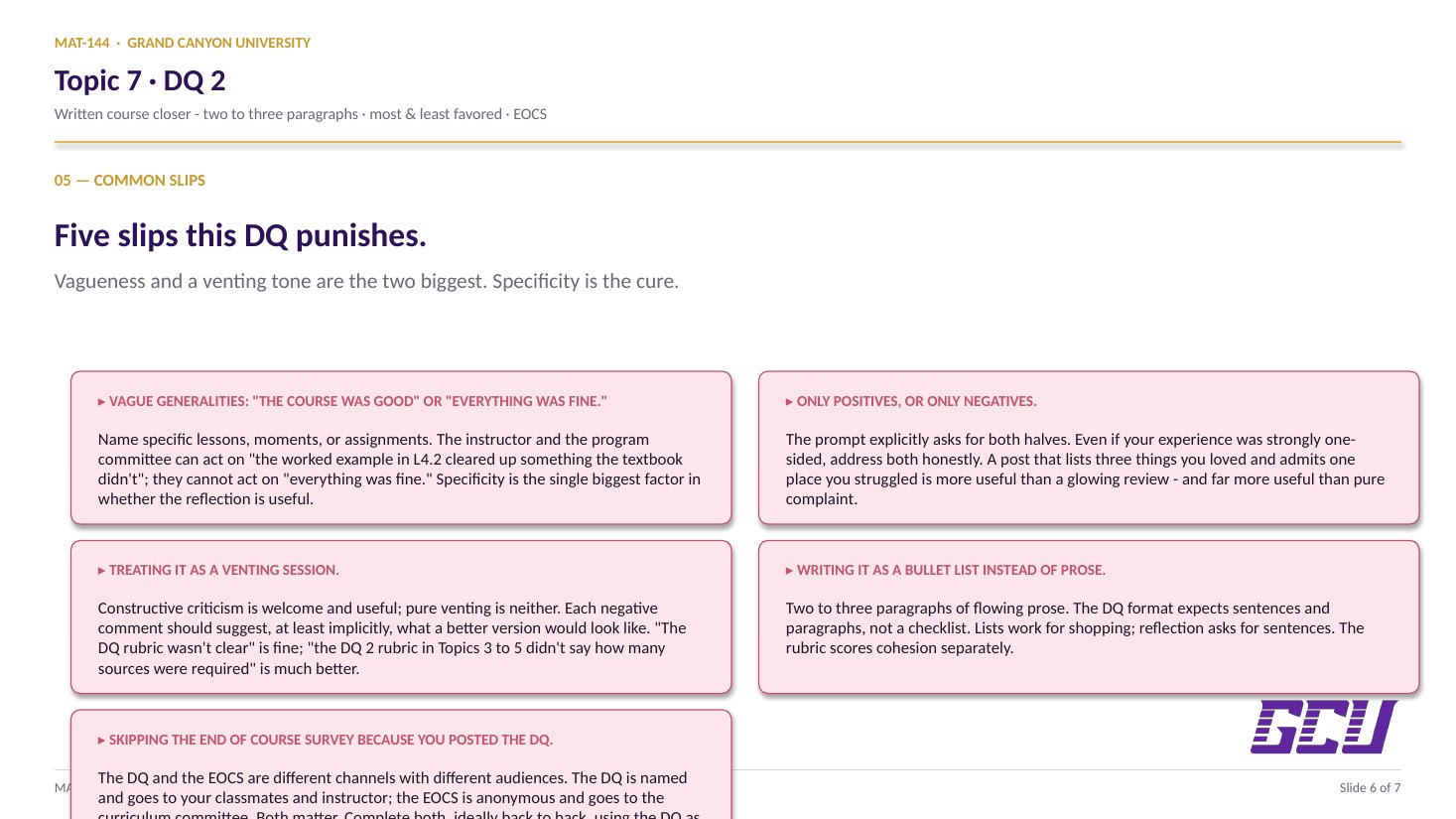
Specificity is the single biggest factor in whether the reflection is useful. Read these before you submit.

  1. 01
    Vague generalities: “the course was good” or “everything was fine.”

    Name specific lessons, moments, or assignments. The instructor and the program committee can act on “the worked example in Lesson 4.2 cleared up something the textbook didn't”; they cannot act on “everything was fine.”

  2. 02
    Only positives, or only negatives.

    The prompt explicitly asks for both halves. Even if your experience was strongly one-sided, address both honestly. A post that lists three things you loved and admits one place you struggled is more useful than a glowing review.

  3. 03
    Treating it as a venting session.

    Constructive criticism is welcome and useful; pure venting is neither. Each negative comment should suggest, at least implicitly, what a better version would look like. “The DQ rubric wasn't clear” is fine; “Specifically, the rubric for DQ 2 in Topics 3-5 didn't say how many references were required” is much better.

  4. 04
    Writing it as a bullet list instead of prose.

    Two to three paragraphs of flowing prose. The DQ format expects sentences and paragraphs, not a checklist. Lists work for shopping; reflection asks for sentences.

  5. 05
    Skipping the End of Course Survey because you posted the DQ.

    The DQ and the EOCS are different channels with different audiences. The DQ is named and goes to your classmates and instructor; the EOCS is anonymous and goes to the curriculum committee. Both matter. Complete both, ideally back to back, using the DQ as your draft.

Application & connection

Thanks for the work. Best of luck on the Final.

This is the closing assignment of the course. You have spent seven weeks building a complete financial-literacy toolkit, and this DQ is the small but real way to close the loop on your experience. A few short paragraphs of specific, honest feedback — what you found valuable, where you struggled, what you would change — matters more than you might think.

Your DQ posts read this week reach two audiences. The first is the instructor: feedback in your own words about what worked and what didn't, in a context where you've actually completed the course and can speak from experience. The second is your fellow students, who are reading and replying to each other's reflections; seeing how others experienced the same seven weeks — what they found hard that you didn't, what they loved that you missed — is itself a useful closing experience.

The complementary formal channel is the End of Course Survey (EOCS), accessed through your GCU student portal. The EOCS is anonymous and goes to the program's curriculum committee for course-improvement decisions; the DQ post is signed and goes only to the class. Both matter, and they ask slightly different questions. Completing both is the strongest way to make your voice heard in shaping future versions of MAT-144.