TOPIC 3 · DQ 2 / Savings / written discussion

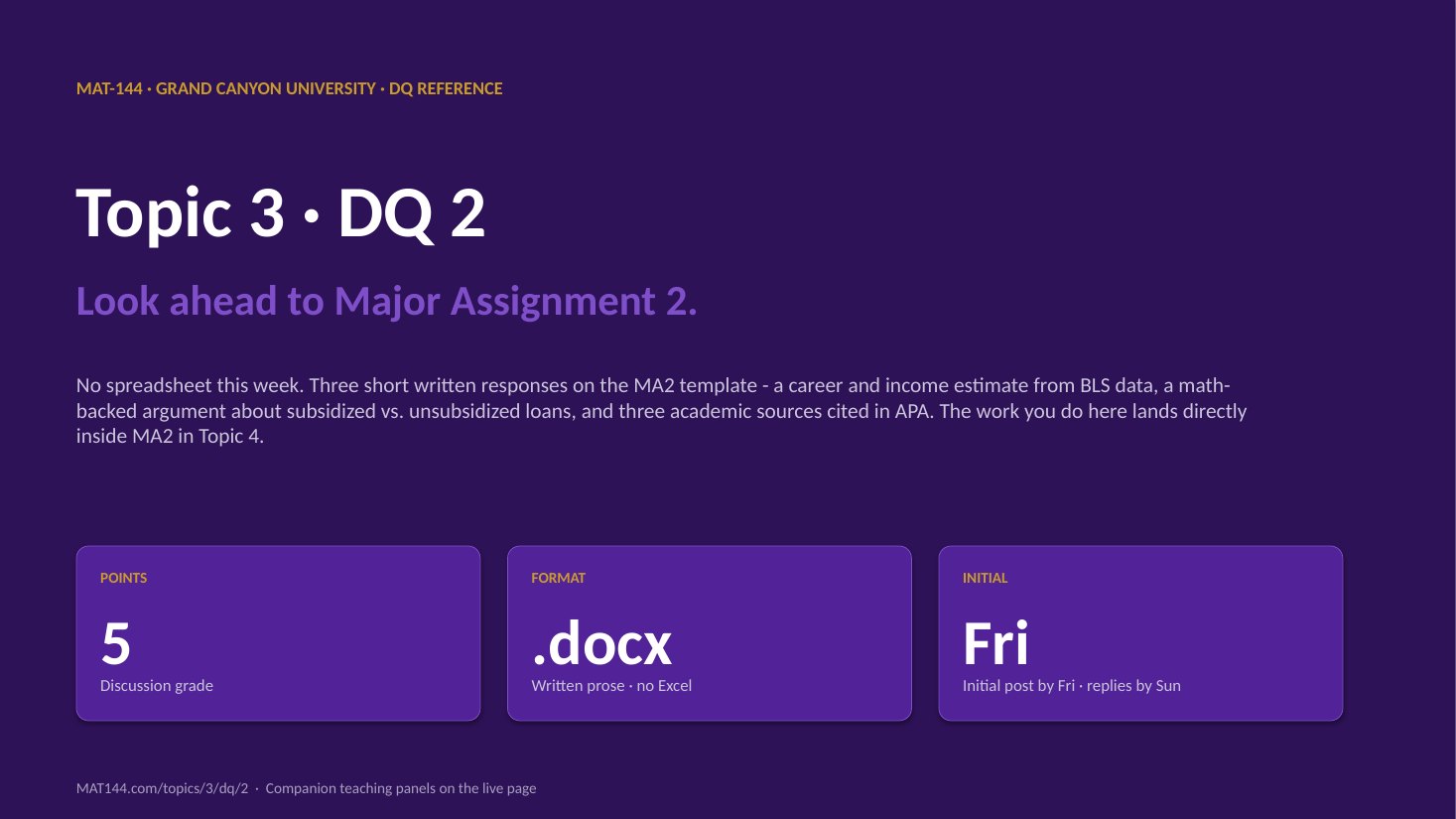
02Look ahead to Major Assignment 2.

Three written responses that preview MA2 in Topic 4: a career and income estimate, a math-backed argument about student loans, and three academic sources in APA. No spreadsheet — your deliverable is paragraphs.

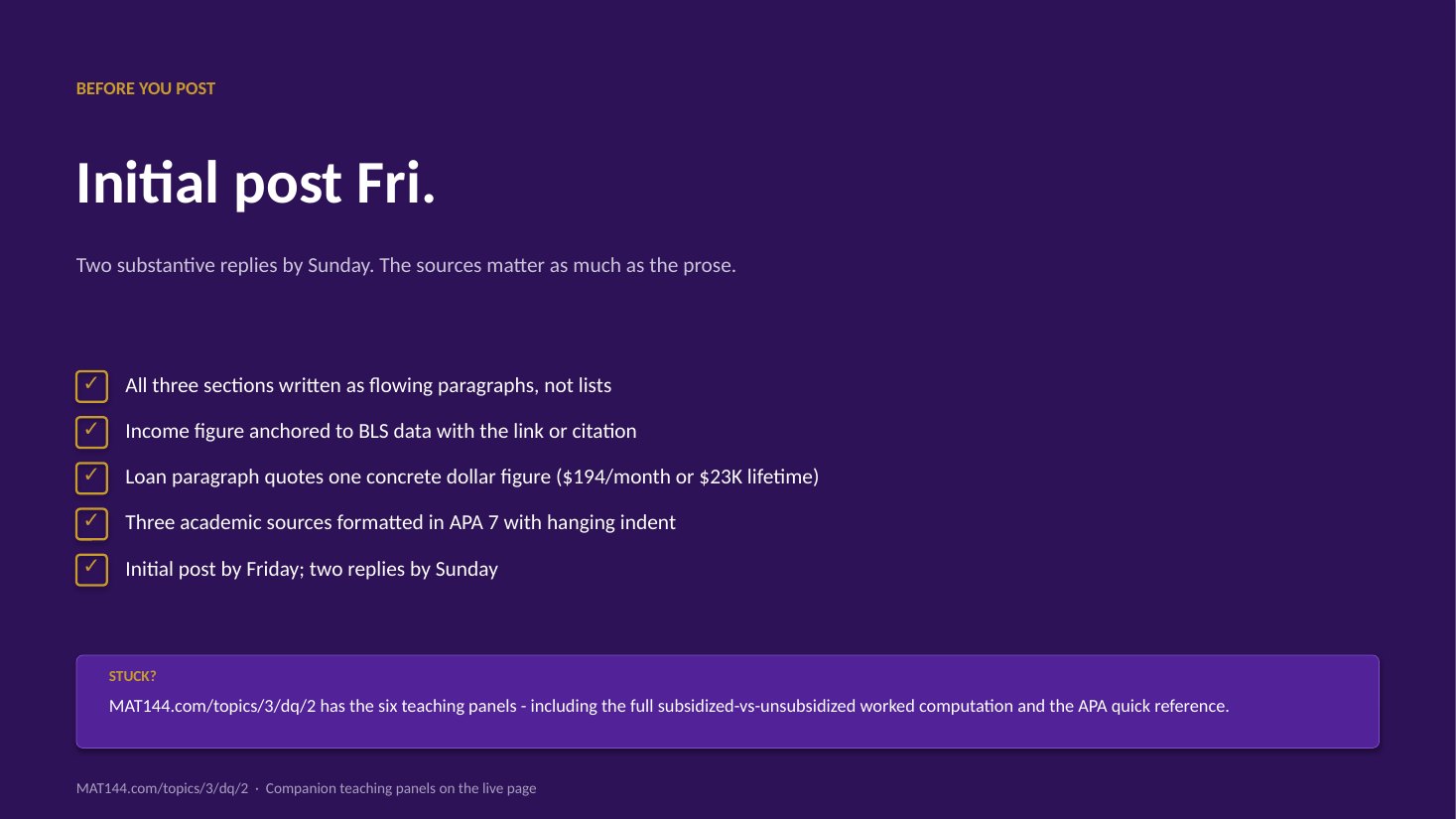
Discussion · 5 pts Initial post Fri · replies Sun Written prose Preview of MA2
1
Step 1 · materials
Download the assignment

Topic_3_DQ_2.docx

DOCX 5 pts MA2 preview
2
Step 2 · walkthrough
Watch the click-by-click

Every keystroke. Pause anywhere; the embed scrolls independently of the page.

SCRIBE.HOW · YOUTUBE
Step-by-step walkthrough
Coming soon. Check back after the Scribe is recorded.
Video walkthrough
Coming soon. Same material, different medium, recorded over the holiday break.
Same walkthrough, two modes. Use whichever helps you today.
ORIENT · the assignment

What's actually being asked.

Three short written responses, all submitted on the MA2 write-up template (not on this page).

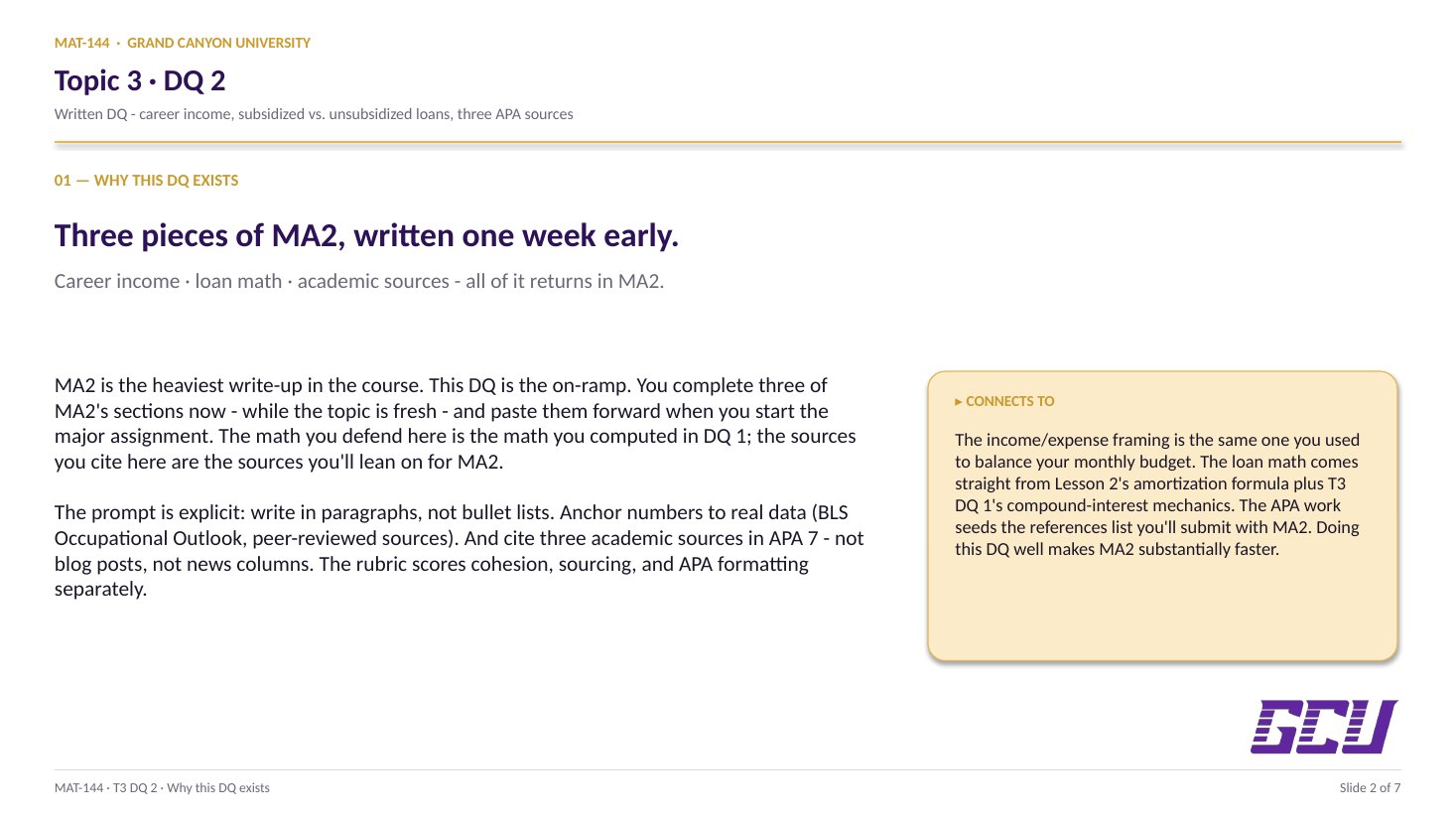
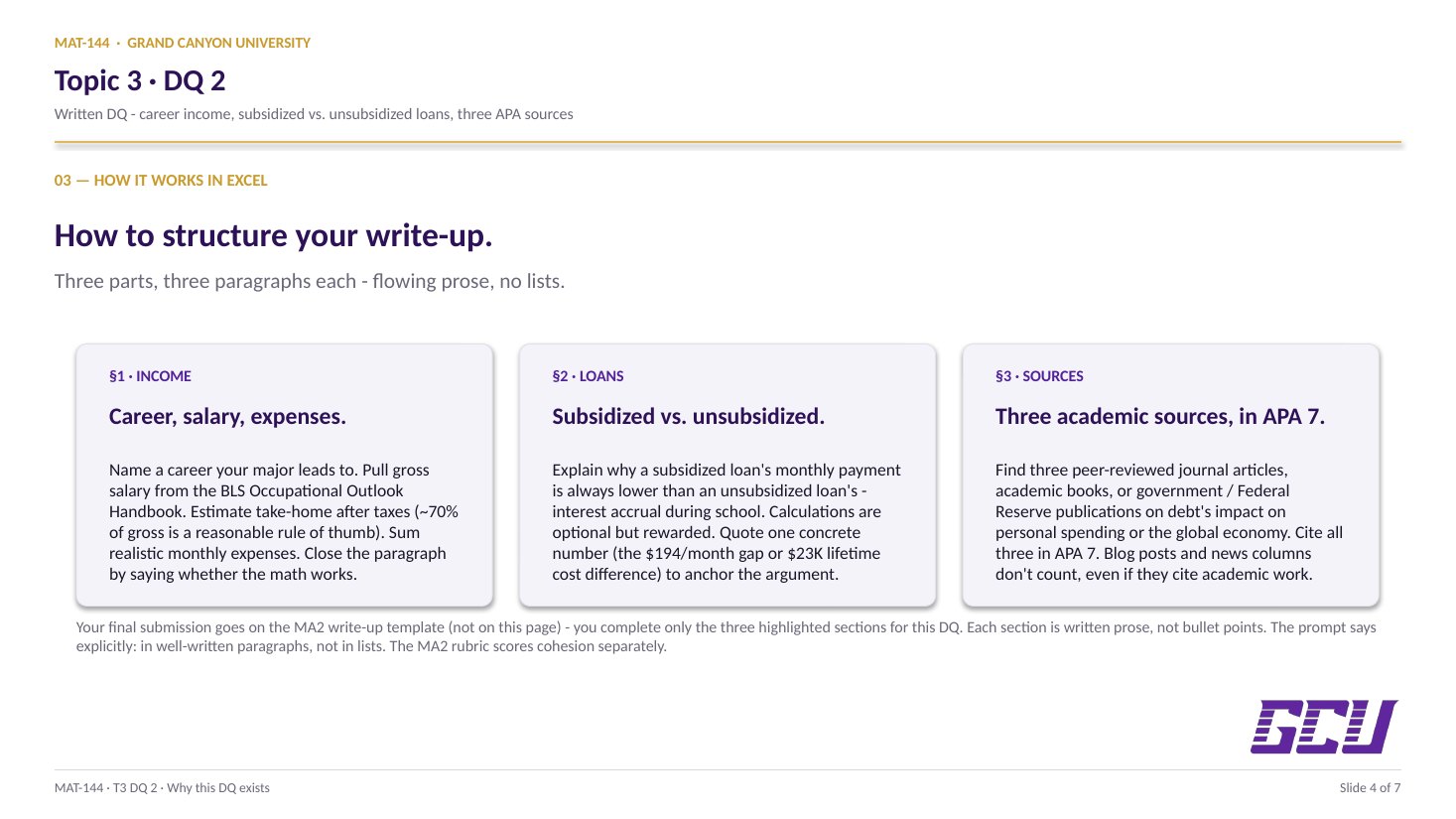
This DQ is structured as a head start on Major Assignment 2. The MA2 write-up has more sections; for this DQ you complete only the three highlighted parts. Each should be written as flowing paragraphs (the prompt is explicit about no lists), and your final submission goes on the MA2 template — not on this page.

Where to find the MA2 template

Submit on the MA2 write-up template, not on this page. The file lives in Halo → Topic 4 tab:

MAT-144-RS-ONL-T4-Major Assignment 2 Write-up Template Online 20250317.docx

§1 · Income & projection

Career, salary, expenses.

Pick a career your major leads to. Estimate gross salary (BLS data), then take-home after taxes, then realistic monthly expenses. End with whether the math works.

§2 · Subsidized vs. unsubsidized

$50K at 8%, 4 years out.

Explain why a subsidized loan's monthly payment is always lower than an unsubsidized loan's, when interest accrues during school. Calculations are optional but encouraged.

§3 · Three academic references

Debt's impact, in APA.

Find three academic sources on the impact of debt on personal spending and the global economy. Cite all three in APA format.

CONCEPTS · six things to know

How to do this DQ.

Six teaching panels, one per skill the DQ asks for. The math card on subsidized vs. unsubsidized is the heaviest one — it gives you the full worked computation behind your explanation paragraph.

01
Income

Income & expenses, three movements.

Pick a career that fits your major, then run the math from income down to what's actually left after expenses. Three movements:

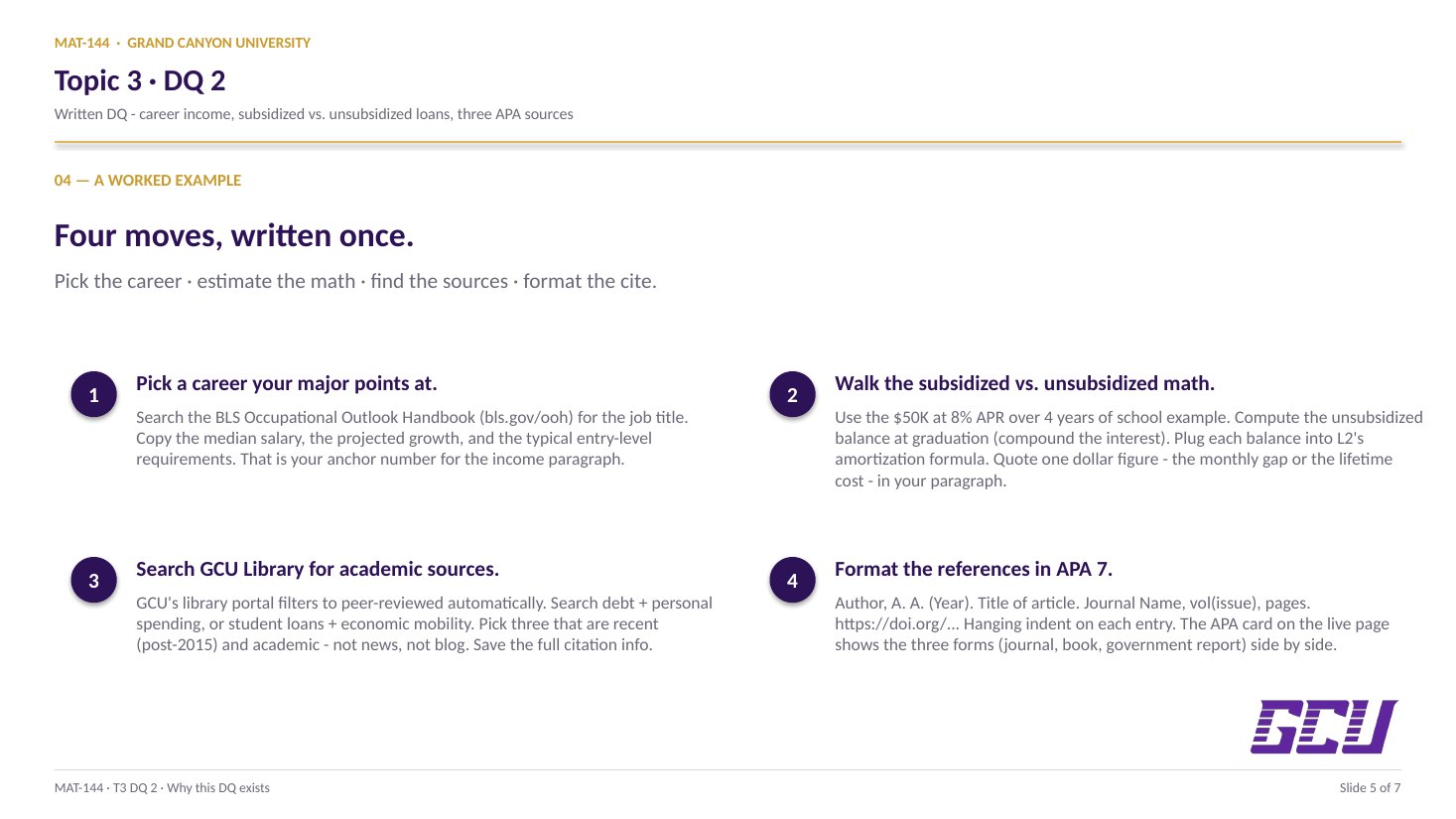
1. Find a credible salary number. The U.S. Bureau of Labor Statistics publishes the Occupational Outlook Handbook (bls.gov/ooh) — type your career and you get median pay, projected job growth, and education requirements. Cite the BLS in your write-up; round numbers from a salary site without a credible source are easy to challenge.

2. Estimate take-home pay. Gross salary isn't what hits your account. Federal income tax, state income tax (varies — Arizona is around 2.5%), and FICA (Social Security + Medicare, ~7.65%) come out before you see a dollar. For budgeting purposes, multiply gross by 0.75 to 0.80 to estimate annual take-home; divide by 12 for monthly.

3. Compare to realistic monthly expenses. The big buckets: rent or mortgage (often the largest line), groceries, transportation (car payment + insurance + gas, or transit pass), health insurance (employer or marketplace), utilities and phone, and at minimum a small savings rate. The DQ asks for a broad estimate, not a polished budget — but the more concrete your numbers, the stronger the response.

Write this as a single flowing paragraph (the prompt is explicit about no lists). Lead with the career and salary, then walk through the deductions, end with whether the math actually works out to a livable monthly surplus.

02
Loans · Concept

Why the subsidized loan always pays less.

The federal government issues student loans in two flavors, and the only difference between them is who pays the interest that accrues while you're still in school.

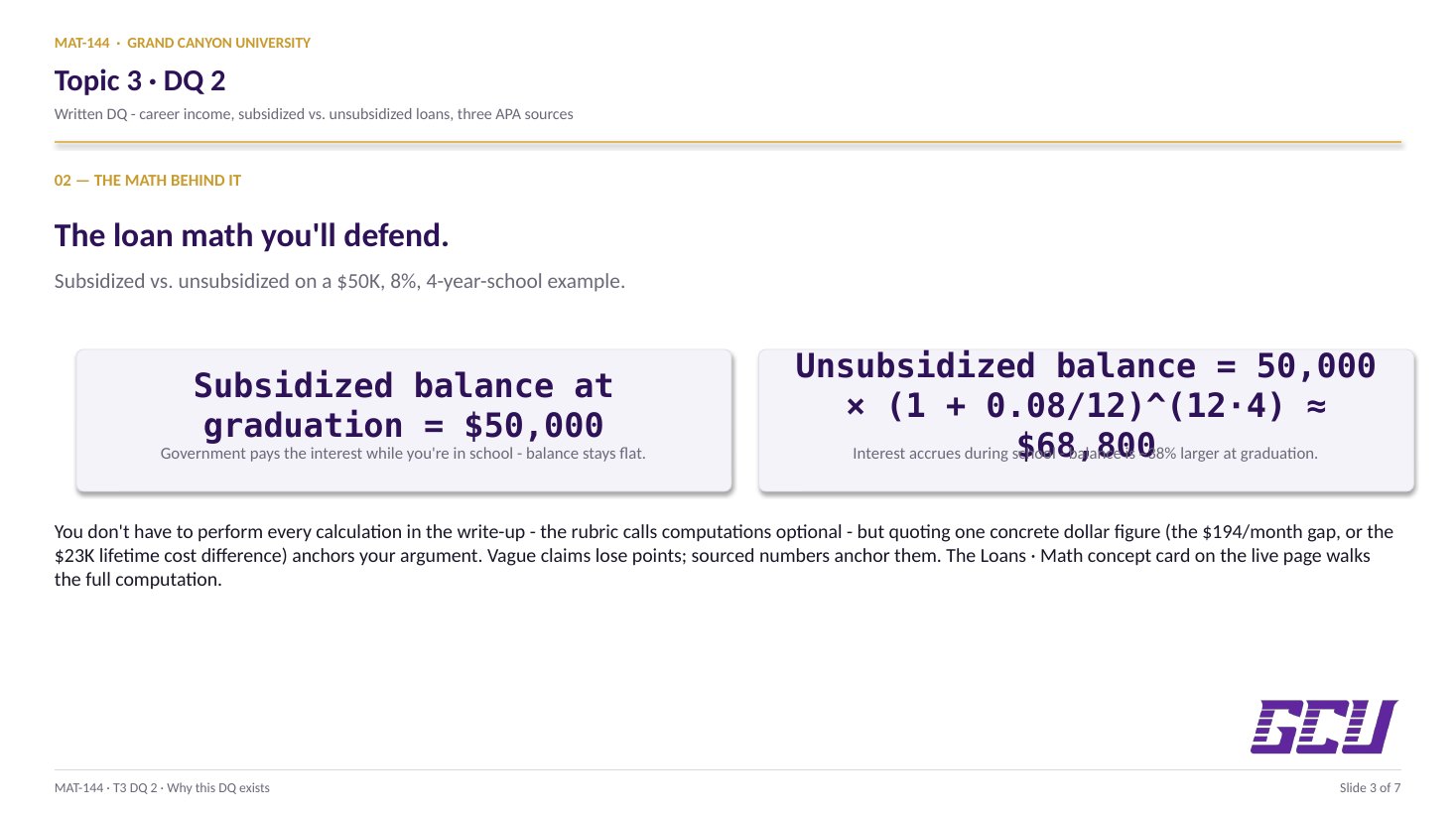
Subsidized loans: the federal government pays the interest during your in-school years (and during certain deferment periods). When you start repayment, the principal is exactly what you originally borrowed.

Unsubsidized loans: interest accrues from the day the loan is disbursed. While you're in school, that interest piles up and gets capitalized (added to the principal) when repayment starts. You then pay interest on the larger principal for the entire repayment term.

The DQ asks you to explain why the subsidized payment is always lower. The short answer: the subsidized loan starts repayment with a smaller principal. For any rate and any repayment term, smaller principal means smaller monthly payment. You can write the explanation as a paragraph; the worked numbers in the next card give you the receipts.

Subsidized
P = $50,000
Government pays interest
during 4 in-school years.
Principal stays the same.
Unsubsidized
P = $66,000
Interest accrues during school
and capitalizes at repayment.
Principal jumps by $16,000.
03
Loans · Math

$50K at 8%, walked through both ways.

Walk through the exact scenario the DQ gives you: $50,000 borrowed at 8% annual interest, repayment starts 4 years from now, with a standard 10-year repayment term.

Subsidized case. The government pays the 8% during your 4 in-school years. When repayment starts, the principal is still $50,000. Plug into the loan amortization formula M = P(r/12) / (1 − (1 + r/12)−12t) with P = $50,000, r = 0.08, t = 10 years:

Subsidized monthly payment ≈ $606.64

Unsubsidized case. Interest accrues during the 4 in-school years. Using simple-interest accrual at 8%: $50,000 × 0.08 × 4 = $16,000 of accrued interest. When repayment starts, that interest is capitalized — the principal becomes $66,000. Apply the same monthly-payment formula with P = $66,000:

Unsubsidized monthly payment ≈ $800.76

The difference: about $194 more per month, every month, for 10 years. Total extra paid: $23,294.89 in interest you wouldn't have paid had the loan been subsidized.

The "always lower" claim is now provable. Both monthly payments are computed from the same formula with the same r and the same t; the only thing that differs is P. The formula is monotone increasing in P, so the smaller starting principal (subsidized) gives the smaller monthly payment. True for any rate, any term — as long as the unsubsidized loan spent any time accruing interest before repayment.

04
Sources

Where to find academic sources.

The DQ asks for three academic sources on the impacts of debt on personal spending and the global economy. A "source" here means peer-reviewed research, government publications, or established academic books — not blog posts, opinion columns, or AI-generated text.

Where to find them:

· GCU's online library (library.gcu.edu) — full access to academic databases like JSTOR, EBSCOhost, and ProQuest. Search "household debt" or "consumer credit" + "economic impact."

· Google Scholar (scholar.google.com) — surfaces academic papers from across publishers. Look for articles with high citation counts and recent publication dates (2015 onward).

· Federal Reserve publications (federalreserve.gov and Federal Reserve Bank research sites like newyorkfed.org) — primary data on household debt, plus working papers from staff economists.

Three real example sources you could cite (do your own search before deciding; these are starting points to show what "good source" looks like):

Mian, A., & Sufi, A. (2014). House of debt: How they (and you) caused the Great Recession, and how we can prevent it from happening again. University of Chicago Press.

Looney, A., & Yannelis, C. (2015). A crisis in student loans? How changes in the characteristics of borrowers and in the institutions they attended contributed to rising loan defaults. Brookings Papers on Economic Activity, 2015(2), 1–89.

Federal Reserve Bank of New York. (2024). Quarterly Report on Household Debt and Credit. https://www.newyorkfed.org/microeconomics/hhdc

The Mian & Sufi book is the standard general-audience academic treatment of how household debt drove the Great Recession — useful for the macro half of the question. Looney & Yannelis is a Brookings paper specifically on student loan defaults — direct fit for personal-debt impact. The NY Fed report is updated quarterly with current debt figures. Use these as a model when finding your own.

05
APA

APA 7 formatting, the three forms.

APA 7th edition (the format GCU uses) follows a consistent structure. The three you'll most likely need for this DQ:

JOURNAL ARTICLE

Author, A. A., & Author, B. B. (Year). Title of the article. Journal Name, Volume(Issue), Page–Page. https://doi.org/xxxx

BOOK

Author, A. A. (Year). Title of book (Edition if applicable). Publisher.

WEBSITE / INSTITUTIONAL REPORT

Author, A. A. (Year, Month Date). Title of the webpage. Website Name. URL

Two formatting rules students miss most often: italicize the journal name and book title (not the article title), and use a hanging indent — the first line of each reference is flush left, subsequent lines are indented half an inch. Word's "Hanging" paragraph style sets it for you.

If you need a deeper APA primer, Purdue OWL's APA reference guide (owl.purdue.edu) has every variant you'll encounter. GCU's writing center also publishes course-specific APA guidance — worth bookmarking for MA2.

Journal article
Author, A. (Year). Title. Journal Name, V(I), pp. https://doi.org/
Book
Author, A. (Year). Title of book. Publisher.
Website / report
Author. (Year). Title. Site Name. URL
06
Writing

What a strong response paragraph looks like.

The prompt says explicitly: write in well-structured paragraphs, not lists. That's not a stylistic preference; the MA2 grading rubric scores cohesion and flow, and a list of bullet points loses those points before you start.

What a strong response paragraph looks like, in shape (do not copy this — the content needs to be yours):

My major is [specific program], and one of the most realistic career paths is [role], which the U.S. Bureau of Labor Statistics reports has a median annual salary near [$X] (BLS, 2024). After federal and state income taxes plus FICA (roughly 20-25% of gross), my approximate monthly take-home would be [$Y]. Realistic monthly expenses in my area would include rent of about [$Z], groceries near [$A], transportation around [$B], and health insurance from a marketplace plan near [$C], leaving roughly [$D] for savings and discretionary spending.

Whether that math actually works depends on cost of living: in [Phoenix area / your region], this would be a viable starting position with a moderate savings rate, while in a higher-cost market it would be tight without a roommate.

Two paragraphs, ~150 words. Specific numbers, one cited source, a clear takeaway about whether the math works. That's the bar. Apply the same shape to the loan paragraph: claim, math, specific numbers, conclusion.

Common slips

Five mistakes this DQ punishes.

These are the predictable losses on this assignment — each one shows up in office hours every term.

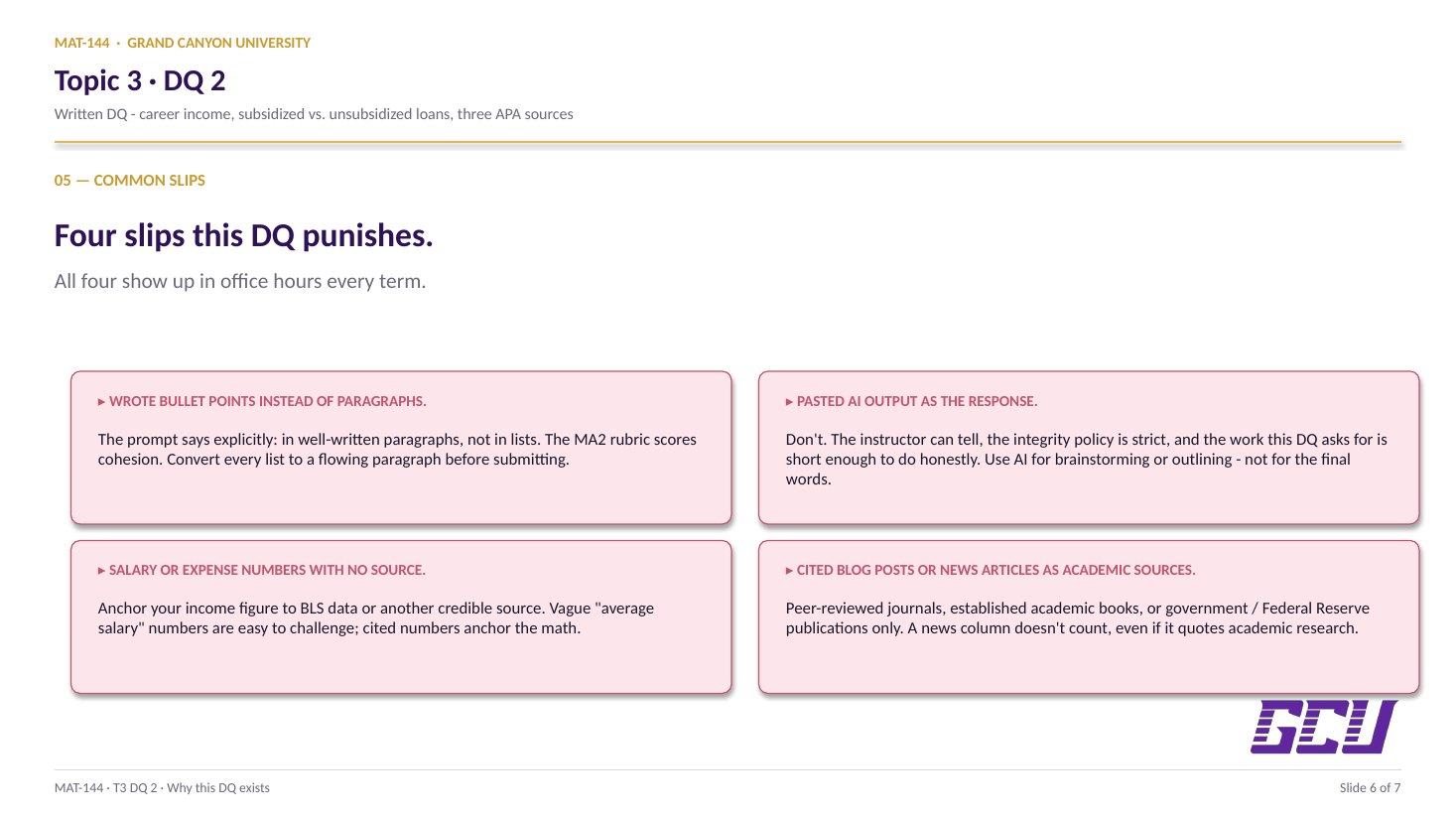
  1. 01
    Wrote bullet points instead of paragraphs.

    The prompt says explicitly "in well-written paragraphs, not in lists." The MA2 rubric scores cohesion. Convert any list to a flowing paragraph before submitting.

  2. 02
    Pasted AI output as the response.

    Don't. The instructor can tell, the integrity policy is strict, and the work this DQ asks for is short enough to do honestly. Use AI for brainstorming, not for the final words.

  3. 03
    Salary or expense numbers with no source.

    Anchor your income figure to BLS data or another credible source. Vague "average salary" numbers are easy to challenge; cited numbers anchor the math.

  4. 04
    Cited only websites or news articles.

    All three sources should be academic: peer-reviewed journals, established academic books, or government / Federal Reserve publications. A blog post or news column doesn't count, even if it cites academic work.

  5. 05
    Skipped the loan math entirely.

    Calculations are optional but the rubric rewards them. The Loans · Math card above gives you the full worked example — quote the $194/month gap or the $23K total cost difference in your paragraph.

Application & connection

MA2 starts here.

This is deliberately a preview. Major Assignment 2 in Topic 4 expands every part of this DQ — your career analysis gets a budget, your loan question gets a written comparison and calculation, and your three references support a longer discussion of debt. The work you do here makes the MA2 write-up faster.

Submit on the MA2 write-up template (the one linked in this DQ's instructions, not on this page). Use complete paragraphs. Cite your sources in APA. Don't paste from an AI. Topic 3's lesson formulas (especially L2 simple interest and L5 annuity FV) are the math you'll lean on in MA2 — you've already done this work.